The letters that John Joyce shared with me were between the family of Edward and Kate Prendergast in Graiguenamanagh (Graigue) and two of the Fitzhenry men who had gone to seek their fortune in South Africa.
The first of the letters was from "Mr John O'Gorman of Killan, Enniscorthy" to "Mr E M Fitzhenry" in South Africa in April 1881.
Edward Fitzhenry was the grandson of James Fitzhenry and Margaret Gorman and the brother of Father James Fitzhenry, who erected the memorial at St Mullins graveyard to his grandparents and the members of his father's generation.
Erected by the Rev. James Fitzhenry (Missionary South Africa) in memory of
James Fitzhenry died in 1847 aged 73 yrs.
Margaret Fitzhenry Nee Gorman died in 1840 aged 65 yrs.
Edward Fitzhenry died 1847 aged 40 yrs.
Patrick Fitzhenry died 1888 aged 84 yrs
Martin Fitzhenry died 1848 aged 46 yrs
Nancy Ryan died 1895 aged 71 yrs
John Ryan died 1879 aged 73 yrs
Judy Ryan died 1852 aged 74 yrs
Edward Ryan died 1891 aged 92 yrs
Edward does not appear on the newest memorial which commemorates the Rev. James Fitzhenry and his other siblings so it is likely he must have died elsewhere.
The text of the letter is about the land reforms in Ireland at the time, and John exhorts Edward not to believe what he reads in the English newspapers
"You would imagine the Irish farmers were robbers and were striving to do the landlord out of his property."
There are hundreds of ejectments (evictions) being served and fighting between the farmers and the police.
"The Whelans are in still and were never tried for the shooting of young Boyd"
I wonder if this the Whelan family of the other St Mullins memorial, in which Ann Fitzhenry married John Whelan.
"We were glad the Boers gave the English fighting enough out there."
John signs off with his regards to Edward and Father James.
What was the family relationship between John O'Gorman and Edward Fitzhenry? As yet I don't know, so if anyone recognises this family, please let me know.
Why not subscribe to this blog and get the updates sent to your inbox? Or send us an email about your Fitz(-)henry family links.
Back to Graiguenamanagh which I'm now going to refer to by it's local shorthand, Graigue.
Mary in the Abbey Centre (where I found the baptism and marriage records, and the St Mullins memorial texts) suggested that I talk to one of the local historians Owen Doyle who had written several books about the town. Mr Doyle said that he couldn't help me as he had no records of Fitzhenrys living in Graigue and suggested I talk to John Joyce, who is considered the local expert on the area.
One phone call later and I was being invited round to take tea with Mr Joyce the following afternoon. Although he had no records of Fitzhenrys living in Graigue in the past 100 years or so, he showed me some letters he had which were part of his late wife's family history which showed that there was a link to a Fitzhenry family in County Wexford.
John Joyce's wife had been a Prendergast before her marriage. Her grandmother was born Kate O'Gorman. Kate married Edward Prendergast, a well to-do merchant in Graigue.
You may remember that on the second Fitzhenry stone at St Mullins graveyard, the wife of
James Fitzhenry (1773 - 1847) was
Margaret nee Gorman (1775 - 1840).
This is the link between the Prendergasts and the Fitzhenrys via the O'Gormans (or Gorman in their more Anglicised version) and the letters leave no doubt that this is the family group in question.
Mr Joyce is a mine of information about the locality of Graigue, the family groups who lived there and the political history of the area. He has written several books about the town. It was truly a wonderful experience to have the benefit of his knowledge and I am very grateful to him for his hospitality that afternoon.
The next post will look at the letters between the Prendergast and Fitzhenry families and the people described in them.
Why not subscribe to this blog and get the updates sent to your inbox? Or send us an email about your Fitz(-)henry family links.
I missed this stone as it was nowhere near the other Fitzhenry graves, and once again I'm indebted to the Bree parish website for evidence of its existence and for the transcription
Here lies the body of PATRICK NOWLAN
departed this life October 26th 1820 aged 19 years.
Also his mother CATHERINE FITZHENRY
Also....................................................
Also the body of ELENOR NOWLAN, her daughter
who departed this life February 8th 1826 aged 24 years.
The missing name is probably (but not defintely) the name of Catherine's husband.
Unfortunately there are no mention of Catherine's forebears or dates but if Catherine had her children in her twenties, then she was born in the 1780s. She probably died between 1820 and 1826 if the deaths are arranged in order.
There are no other Nowlans buried in the graveyard but there is a collection of Nolans from Sparrowsland, a township just south of Ballybrennan.
This is the last post about Ballybrennan graveyard and indeed the last of the Wexford Road Trip series.
We did have a brief look around New Ross when we passed through, but didn't find anything worth reporting on (apart from the New Ross Piano Festival, including an open air concert in the main street). New Ross will be a project for the next trip.
Why not subscribe to this blog and get the updates sent to your inbox? Or send us an email about your Fitz(-)henry family links.
... the first stone so named because it was raised up about a foot by stone blocks at each corner. This was another stone that was absolutley covered in white and grey lichens. This photo gives an idea of what it looked like, but I couldn't get a photo that showed the writing in any detail. The Raised Stone also had the headstone for Ann Fitzhenry resting against it, although the position for this was probably originally next to that of Edward Fitzhenry.
The Broken Stone was just so broken that I needed the transcription from the Bree parish site to make any sense of it. The broken stone appears to be the original stone for this family, with the Raised Stone being the replacement. They both refer to the Fitzhenrys of Gobbinstown
Here's the relative postions of the stones and here are the transcriptions - the Broken Stone first.
Here lies the remains of NICHOLAS FITZHENRY
of Gobbinstown Esq.,
a man that was universally esteemed for his good life unbounded charity,
benevolence and......of the poor
who departed this life on the 27th day of July 1793 aged 61 years.
Also in memory of his son BRYAN FITZHENRY Esq. late of Gobbinstown
who departed this life on the 11th July 1832 aged 66 years.
His grandson MEYLER, son of the above BRYAN
departed this live on the 28th of November 1830 aged 23 years.
And also his daughter-in-law JOHANNA FITZHENRY wife of the said BRYAN
who departed this life on the 16th of December 1840 aged 63 years,.
Also BRYAN FITZHENRY Esq. of Gobbinstown
who departed this life on the 19th of June 1863 aged 62 years.
Also two of his children MEYLER and ELIZA who died young
"Stay reader, weep......mindful of thy condition and pray to God....a devout mind".
Lord have mercy on their Souls
Here is the transcription of the Raised Stone
Beneath the lamb lieth the remains of
NICHOLAS FITZHENRY Esq. late of Gobbinstown
who departed this life on the 27th of July 1793 aged 61 years.
Also his son BRYAN FITZHENRY Esq.
who departed this life on the 11th June 1832 aged 66 years
Also his grandson MEYLER and son to the above BRYAN
who departed this life on the 28th of November 1830 aged 23 years
Also his daughter in law JOHANNA FITZHENRY, wife to the said BRYAN
who departed this life on the 16th of December 1810 aged 63 years
Also BRIAN FITZHENRY Esq., Gobbinstown
died 18th of June 1862 aged 62 years.
Also two of his children MEYLER and ELIZA who died young.
Also his son BRYAN FITZHENRY
who departed this life on the 19th of October 1875 aged 51 years.
Req.’t in pace
The Raised Stone has an extra person - Bryan Fitzhenry who died in 1875 and this suggests that this is the newer stone and it was replicated somewhere between 1862 and 1875, probably at the Bryan's death in 1875.
There is also another of the confusions between one and four in Johanna's death, but looking at the dates when she would have borne her children, I put her death in 1840.
The infant children Meyler and Eliza are a mystery - are they the children of Nicholas, or those of Brian who died in 1862? My thoughts are that they the children of the latter and that the Bryan Fitzhenry who died in 1875 is also the son of Brian Fitzhenry.
And ... considering the strong hereditary naming pattern, I also speculate that Nicholas is another son of Bryan Fitzhenry (1693-1770), the father of William "Billy" Fitzhenry of Ballymackessy (1728-1811) and grandfather of Jeremiah Fitzhenry of Boro Hill.
If anyone has information that confirms or refutes this, please let us know.
Why not subscribe to this blog and get the updates sent to your inbox? Or send us an email about your Fitz(-)henry family links.
The star gravestone of the collection, but the one that I couldn't read because of the lichen covering and the railings prevented me from getting a closer look! So I'm indebted to the transcription made by Bree parish and published on their website.
I think the lichen must have also been a problem when they transcribed the inscription as I have two corrections:
Jeremiah Fitzhenry died in 1845 rather than 1815 (that problem with the indistinct fours again!)
William Fitzhenry did die in December 1811, but he was 83 years old, rather than 3 years old.
Here's my amended version:
This monument has been erected by WILLIAM FITZHENRY
to the memory of his son LUKE FITZHENRY
as a lasting proof of the high esteem in which he held his filial piety and other values.
He was born 26th December 1772 and died 2nd July 1807
aged 35 years.
Here also lies the remains of BRIAN FITZHENRY
who died 1st May 1780 aged 18 years
Also the remains of WILLIAM FITZHENRY, Ballymackey
who died the 23rd of December 1811 aged 83 years.
Also the remains of JEREMIAH FITZHENRY of Borohill
who died the 23rd of February 1845 aged 73 years
and to whom memory this monument is particularly erected.
May they rest in peace
Amen
I've written more about the family history of these men in a previous posting, but if anyone has any more information, I would be very grateful to receive it.
Why not subscribe to this blog and get the updates sent to your inbox? Or send us an email about your Fitz(-)henry family links.
This stone lay on the ground adjacent to the Long Flat Stone and is of the same length. I expect it originally was also designed to mark a family grave, but the inscription only took up about the top third as it only commemorated two people. It was broken across the writing but this was easily readable and here's a photo.
Underneath lieth the body of
Mr Bryan Fitzhenry of Ballymack'y
who died August 16th 1770 aged 71 years
Also the body of Mrs Fitzhenry
alias Mary King who died Feby 27 1779
aged 87
May they rest in peace
Given these dates, Bryan was born in 1693 and Mary in 1692.
Ballymack'y is an abbreviation of Ballymackessy.
So why didn't they have the rest of the family buried with them? Bryan and Mary were the parents of William "Billy" Fitzhenry and grandparents of Jeremiah. These two men are buried (with others) under the stone surrounded by the iron railings. Perhaps the elevated status of the Fitzhenry family at this time led to them having a more up-market grave. Here's more about this family from a previous posting. The gravestone of Bryan and Mary lies at the head of the railings and their relative postions can be seen here.
Next post: The grave of Jeremiah Fitzhenry
Why not subscribe to this blog and get the updates sent to your inbox? Or send us an email about your Fitz(-)henry family links.
.... so named as it was a long bit of stone lying flat on the ground. It takes up three photos on the webalbum.
They crammed a good few Fitzhenrys into this plot.
Here's the inscription and this one gave me a few problems - it looks very easy to read from the photos. Nice carving, words didn't break across the lines and relationships nicely explained - a researcher's dream.
BUT me and the Bree Parish website had a few differences especially over the use of the number 4
AND my last few burials were out of time sequence.
That's when it struck me - since the Bree parish transcriptions had been made, the lichen had done it's job and filled in most of the fainter diagonals on the number fours in the carvings. So where I had the last five deaths initially as in 1812, 1815, 1811,1815 and 1865, looking at the ages of death of these people (and readjusting the age of one from 18 to 48) gave the much more satisfactory transcription below. I stand by calling the third person MILER instead of MILES though - that's definitely there on the stone and you can see for yourself in the first of the "Long Flat Stone" pictures.
I don't know what the relationship between the first two people (Mary and Nicholas) are to each other or to the family described on the rest of the stone.
Here lies the Body of MARY FITZHENRY
who died May the 7 1778 aged 17 yrs
Here also lieth the remains of
NICHOLAS FITZHENRY of Rathiurun
who died August the 10th 1793 aged 71 years
here also lieth the remains of MILER
FITZHENRY of Rathiurun who died Feby
1 1816 aged 73 years also his wife MARY
FITZHENRY who died July the 9th 1829
aged 75 years Also his daughter
CATHERINE FITZHENRY alias DOWNES
who died Sept the 18th 1812 aged 28 years
Also his son MICHAEL FITZHENRY who died
June the 9th 1815 aged 33 years
Also his daughter ANNE FITZHENRY
who died July the 19th 1841 aged 48 years
Also his daughter ELLEN FITZHENRY
who died June the 22nd 1845 aged 52 years
Also his son NICHOLAS FITZHENRY
who died April the 9th 1865 aged 73 years
Why not subscribe to this blog and get the updates sent to your inbox? Or send us an email about your Fitz(-)henry family links.
I transcribed what I could read from the gravestones at Ballybrennan graveyard, knowing that I already had a version of the transcriptions from these stones on my database. The lovely local history group from Bree parish had already put them on their website and I had found them some time ago. They are an invaluable addition to what I could read (or not!) but there were some minor errors in their transcriptions which had an important bearing on some people's dates. And it was really exciting to know that these people were the kin of Jeremiah Fitzhenry and that I had made another link.
The stones of Edward Fitzhenry and Ann Fitzhenry were the oldest stones of the Fitzhenry group in Ballybrennan graveyard. They are very rough hewn, the carving is quite basic and the mason (it seems like the same mason for both stones) had decided that if you reach the edge of the stone when you are only half way through a word.... you just continue that word on the next line.
Here's what on the stones as the words are written (slightly different to how they appear on the Bree parish website)
IHS
HERE LYETH Y BODY
OF ANN FITZHE
NRY ALS ROCH
WHO DEPARED
THIS LIFE AUG Y
25 1753 AGED 43
There's two interpretations of this - she was either Ann Fitzhenry who married a chap called Roch, or she was Ann Roch who married a Fitzhenry. Either could be true - she could be the wife of Edward, hence the similar gravestones and buried in proximity, or she could be perhaps a relative of Edward who married a Roch but was brought home after death to be buried in her own family plot.
Either way she was born around 1710.
And Roch was probably spelt Roche.
IHS
HERE LYETH Y BODY
OF EDWARD FITZHE
NRY WHO DEPART
THIS LIFE JUNE Y 27
17** AGED **
Edward is a bit more straightforward for his family origins. He's a Fitzhenry.
But the year of his death was virtually illegible, as was his age which looked to me very much like 22.
I expect that the year is somewhere around 1750 (assuming that this is the same mason and allowing for the fact that these two deaths have happened within the mason's working life).
If he was aged 22 at death he could have been Ann's son, a very younger brother or her husband that she lost early in their marriage.
These two are "orphans" in my Wexford Fitzhenry family group (not linked to anyone at all), so if anyone has any information as to who I can link them to, this would be very gratefully received.
Tomorrow: The many Fitzhenrys of the "Long Flat Stone"
Why not subscribe to this blog and get the updates sent to your inbox? Or send us an email about your Fitz(-)henry family links.
To recap... I spent a couple of hours at Wexford County library where I was delighted to find two articles about the family of Jeremiah Fitzhenry of Boro Hill (written by members of the Wexford Historical Society) and a book about Templeludigan in which I found some Fitzhenry priests.
The main article about Jeremiah Fitzhenry said that he was "buried in Ballybrennan (Bree) graveyard. An iron railing surrounds his grave...around him lie his kinsmen, the Fitzhenrys of Ballymackessy, Rathurtin and Gobbinstown"
We found Bree on the map and away we went up the R730 from Wexford to Kiltealy. The road off this to Bree was a single track road leading to the small village. The church had a very neat and compact graveyard - and no Fitzhenrys. The new cemetery a few hundred yards down the road was too new to have the grave we were looking for. Andy rolled his eyes in disbelief as he could sense another fruitless search (he's put up with a few of them over the years....). Luckily the people in the village shop knew exactly where we were looking for and sent us off down another single track road... back onto the R730, only a bit further north from where we had turned off it in the first place.
So Ballybrennan graveyard perhaps once had a church - there's certainly a ruined something in the middle of it - but it stands in glorious isolation to one side of the the main road. It doesn't seem like it's had a recent interrment and the only way in seemed to be a set of stone steps leading up to a gap in the wall through the hedge. The graveyard was surrounded by open county and was gloriously full of rabbits - in fact rabbitty burrowings seemed to have been the cause of a lot of gravestone subsidence. Some of the earliest headstones were from the early 18th century and the carvings on them were quite primitive looking with depictions of the crucifixion, the tree of life and the sun.As there's not space to put all of the photos here in the blog, you can find them here in my Picasa webalbum by clicking on the photo below:
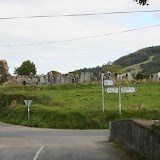 Ballybrennan graveyard.
The light wasn't brilliant for showing the words on grey granite covered in lichen, but I hope they give you a feel of the stones.
 The small collection of Fitzhenry graves does merit a picture here on the blog. If you click on the picture to enlarge it, you will see that I've annotated the stones with who they belonged to. As described, Jeremiah's grave was one of the few in the graveyard with railings around it although the rest of his family had no such ornamentation.
Coming up the next couple of postings - the gravestone transcriptions.
Why not subscribe to this blog and get the updates sent to your inbox? Or send us an email about your Fitz(-)henry family links.
Edward Hay, the Irish Historian and member of the Royal Irish Academy wrote of the old Wexford Brdge:
The remarkable wooden-bridge built in 1795, over the mouth of the Slaney, leading northward from the town, is undoubtedly a very great curiosity, being fifteen hundred and fifty-nine feet long, with a portcullis, and thirty-one feet wide through its whole extent, with a toll-house at each extremity.
On each side are foot-ways, ornamented with chinese railings supported by strong bars. There are also two recesses, with seats for shelter against sudden showers for it is the beau walk of the town, and thus contributes much to the tolls collected to defray the expence of the building
.
From:
History of the insurrection of the County of Wexford, A. D. 1798:
including an account of transactions preceding that event, with an appendix
Edward Hay
Printed for the author, by J. Stockdale, 62 Abbey Street, Dublin. 1803
You can read the whole book on Google books.
Why not subscribe to this blog and get the updates sent to your inbox? Or send us an email about your Fitz(-)henry family links.
Continuing from my last post, here is a precis of the other article from the Journal of the Wexford Historical Society. Entitled "The House that Jack, Bryan or Jeremiah Built" it looked at the history of Boro Hill, the main house of the estate that the Fitzhenry family held from the Carews. Tom McDonald has thoroughly researched the history of the house, and here are the edited highlights of an excellent article.
Jeremiah is described as the "wayward and notorious son" of William ("Billy") Fitzhenry, the tennant of all Ballymackessy and estate agent to the Carews from about 1750 to his death at 83 in 1811.
Until 1745 Ballymackessy was leased to Jack Hogan, who ran into debt and lost the tenancy. From 25th March 1746, the Carews leased Ballymackessy to Bryan Fitzhenry, father of Billy. Bryan was married to Mary King of the wealthy Macmine family. Tom McDonald speculates that he could be the same Bryan Fitzhenry living at Killegney who was given a lease of Clohass by his father John Fitzhenry in 1736.
On 3rd February 1756, Bryan Fitzhenry and Luke Hegarty (of Kilcoletrum, Co. Carlow) made arrangements for the upcoming nuptuals of their children Billy Fitzhenry and Kitty Hegarty (although the actual year of the marriage is not stated). Bryan demised Ballymackessy to Billy and in parallel, Myhill King of Macmine (Billy's uncle) demised to Billy one half of the town and townlands of Courtnacuddy. Kitty brought a dowry of £200 to repay Myhill King for the lands. The significance of this arrangement was that if Billy died, Kitty could not bring a second husband to the estate and that the lands would transfer to any issue of the marriage.
The first son of this marriage Bryan, died in childhood. As well as Jeremiah born in 1772, the Carew estate ledgers suggest there were two other sons Myles and Luke, and possibly a John.
Jeremiah was married sometime just before the Rebellion of 1798 to Mary Catherine Colclough sister of John Colclough of Ballyteigue castle, the executed leader of the United Irish. He leased lands from his father, possibly the equivalent of Boro Hill farm but these were demised back to his father when he went to France after the Rebellion. Billy also had a daughter Mary, who married William Evans a widower of Ballymacwilliamroe County Carlow in 1812. Billy had made Mary "devisee and sole legatee" of his will, and in anticipation of the marriage he directed that the Fitzhenry coat of arms be amalgamated with the Evans coat of arms and that henceforth that William Evans should be known as William Evans-Fitzhenry.
Billy Fitzhenry died in December 1811, and as we saw from the other journal article about Jeremiah, it was April of that year when he deserted from Napoleon's army. The pressing need to sort out the family estates may have had something to do with his decision. It seems that Jeremiah and Mary were in bitter dispute about the lands and also the money that had come into the Fitzhenry estate from their mother's dowry. In 1816 when Mary and her husband had run up debts after prolonged litigation, they had to remorgage, amongst other estates, Ballmackessy. In 1818, Jeremiah bought out the mortgage and this is when his permanent residence of Boro Hill began up to his death in 1845.
THe full text of this article is due to be available on-line through the Wexford Library service. So far, they have reached volume 17 of the Journal and this is from volume 19. I will add a link when it arrives. It's well worth a read.
The House that Jack, Bryan or Jeremiah Built
Tom McDonald
Journal of the Wexford Historical Society
Number 19 2002-3
Why not subscribe to this blog and get the updates sent to your inbox? Or send us an email about your Fitz(-)henry family links.
The first of the articles form the Journal of the Wexford Historical Society which I obtained from Wexford library was about Jeremiah Fitzhenry, one of the leaders of the 1798 rebellion. Here's a summary of his history. When the full text of this article is available on-line via the Wexford library (the digitisation process is happening at the moment) I'll add a link.
I'm indebted to William Sweetman, a member of the Wexford Historical Society who wrote this article as it gives us more information about the Wexford Fitzhenrys. As he said:"During the commemoration of the bicentenary of the 1798 rebellion, no mention was made of Jeremiah Fitzhenry: this article attempts to redress that omission"
Jeremiah Fitzhenry was born in about 1772, the son of William Fitzhenry and grandson of Bryan Fitzhenry of Ballymackessy. The Fitzhenrys were tennants of Lord Carew of Castleboro and Bryan held about 300 acres.
In 1790 the lands were divided and the part held by Jeremiah was named Borohill.
In his mid-twenties, he married Mary Colclough, sister of John Henry Colclough of Ballyteigue, who was executed by the English for his part in the 1798 rebellion.
In the spring of 1798, Jeremiah was made a freeman of Enniscorthy.
Jeremiah's part in the rebellion is unclear. Miles Byrne, (whose autobiography is now digitised on Google books) and who like Jeremiah, went to fight in the Irish Battalion of the French army, wrote
I met Jeremiah Fitzhenry in Paris in 1803. He had taken an active part in the County Wexford insurrection in 1798 being with Bagenal Harvey at the battle of New Ross on the 5th June. After the execution of his wife's brother... he came over to France with his wife and two little girls. He went to live at St. Germain-en -Laye... Fitzhenry's wife was brought to bed of another little girl at St. Germain and he, seeing hostilities were on the point of breaking out between England and France in 1803, hastened to send his wife and three childen back to Ireland.
Mrs Fitzhenry took a house at Ballyteigue and then moved to her in-laws at Ballymackessy in 1804.
By 1807 Jeremiah had joined the Irish battalion fighting for the French (under Napoleon) in Spain. Byrne describes him thus:
No man rode better than he did... He was a very handsome man, six feet high and about thirty six years of age
However Fitzhenry was passed over in promotion, and in April 1811 he deserted from the French army. He was received into the camp of the Duke of Wellington at Salamanca and returned to Ireland, not having seen his family for 8 years. He was granted a Royal pardon both for his participation in the 1798 rebellion and for fighting for the French army.
He returned to Ireland to spend the rest of his days at Borohill with his family. He died on 25 February 1845 and is buried in Ballybrennan graveyard.
The full text of the article is from:
Jeremiah Fitzhenry - a chief who knew how to command
William Sweetman
Journal of the Wexford Historical Society:17 (1998-99), 144-158. ISSN 0790-1828.
Why not subscribe to this blog and get the updates sent to your inbox? Or send us an email about your Fitz(-)henry family links
I had phoned the Wexford library before I started my holiday, to make sure that they would be open and also that I would be allowed to use their facilities. As I have come to expect from librarians and archivists, they couldn't have been more helpful. I had expected the library to be a large modern building befitting the county town of Wexford, but in fact it was a (very) small and homely single storey building tucked away in the middle of Wexford city itself. Significant Other was dispatched off to amuse himself in Wexford for an hour and I settled down to find Fitzhenrys. One end of the reading room was taken up by a crowd of elderly ladies having either book club meeting or a parish council meeting (tea and biscuits provided). I found myself a small desk next to the microfilm readers and chatted with a late middle aged man from London who was trying to find the family of his illegitimate grandfather who had been adopted out as a baby.
I had gone to get copies of two articles about Jeremiah Fitzhenry, one of the leaders of the Irish uprising of 1798, published in the Journal of the Wexford Historical Society. By chance, in the local studies section, I also found a book* written and published by the people of Templeudigan or Templeludigan about their village. Here's where it is on the map.
One of the chapters about the priests of Templeudigan had two Fitzhenry mentions
Rev. James Fitzhenry was a native of Monamolin. Born in 1846 he was son of Michael Fitzhenry and his wife Mary (nee Meyler, Adamstown). Ordained to the priesthood, he ministered to the Cape Colony South Africa and died in Grahamstown on 30 April 1919. In August 1888 he donated the 14th station of the Cross to the new Catholic church at Templeudigan in memory of his parents.
Rev. Walter Fitzhenry was a nephew of the above Fr. James Fitzhenry. He was born on 22 December 1904 in South Africa, the son of Edward Fitzhenry and his South African born wife Mary J Coughlan. The family returned home to Monamolin. He was ordained to the priesthood in Rome in 1928 and was a member of the Order of St Augustine. He died at St john's Priory Dublin on 5 February 1961.
I hope I can get permission from the book's authors to put the pictures of these two priests on this website as Father James is just the spitting image of my Dad as a young man - there must be some shared genes in there!
*Templeudigan - Yesterday and Today
Templeudigan Historical Society
ed. Seamus S. de Val
Dec 2001
Why not subscribe to this blog and get the updates sent to your inbox? Or send us an email about your Fitz(-)henry family links
After the disappointment of finding a modern Wexford Bridge on our first night in the city, I started my quest for the old one at the tourist information office the next morning. When I asked about the old bridge, the woman behind the counter seemed pleasantly bemused, but directed me about half a mile upriver "next to the yacht club" but warned me that all that was left of it now were the ends each side of the river.
We took a stroll along the quay next to the fishing boats now pulled up for the day, and passed the shops, the Bullring Square with its statue of the Pikeman to commemorate the 1798 rebellion, we passed the railway station... and seemed to be heading out of town.
 There was no sign to the old bridge, but a right turn off the main road took us to the yacht club ... and there we were. The south-eastern end of the bridge was an extension of the yacht club car park. No plaque or memorial. I took a few pictures and wondered why the bridge, the site of so many executions on both sides, seemed to have been forgotten... and why it was so far out of the town centre.
The question was answered when I later took a proper look at the new bridge and its commemorative plaques.
The 1790s bridge which I had been looking for stood on the same site as the modern bridge. The ruined bridge I had found earlier was an 1850s replacement - it had played no part in the rebellion hence no-one had marked its demolition.
The other plaque marked the most notable persons to have been executed on the bridge. Amongst the names on the Loyalist side was Samuel Atkin from Wendy Rutter's Fitzhenry-Atkin family of Oulartwick. Amongst the names of the United Irishmen was Dr John Colclough, the brother in law of Jeremiah Fitzhenry, one of the leaders of the Rebel forces.
Here are the transcriptions of both plaques:

WEXFORD BRIDGE
1795 Timber bridge constructed on this site by Lemuel Cox of Boston
1827 Bridge repaired and strengthened after storm damage
1856 Replaced by a new bridge constructed 3/4 mile upstream by Pierce Brothers
1959 Prestressed concrete bridge constructed by Ascon Limited
1997 Replaced in 10 weeks with steel structure
Main contractor Ascon Limited
Consulting Engineers: John B Barry & Partners Limited

During and after the insurrection of 1798
Wexford Bridge was the site of many executions
Some ninety Loyalist prisoners
were put to death, among whom were
Edward Turner, Magistrate; David Dalton,
Thomas Ganford, Samuel Atkin,
Francis Plumer, William Baubier,
Benjamin Sunderland, George Sparrow,
John Smyth and Kenneth Mathewson.
Amonst the sixty-five United Irishmen
executed were the leaders Beauchamp
Bagnal Harvey, Dr John Colclough,
John Kelly, Cornelius Grogan, Patrick
Prendergast, Fr. Philip Roche, John
Herron, Edward Frayne, Esmond Ryan
and Matthew Keugh
AH DHEIS LAMH DE GO RAIBH SIAD
Why not subscribe to this blog and get the updates sent to your inbox? Or send us an email about your Fitz(-)henry family links.
 When me and my better half Andy went to Ireland last month, he thought he was getting a relaxing few days of sight-seeing, good food and whale-watching. I also managed to sneak in a few bits of Fitzhenry family history research which makes up the "Wexford Road Trip" series.
After arriving by ferry from Wales we spent the first night in Wexford City itself. Here's its page on Wikipedia. The old part of the town is very compact and on the south east side of the estuary of the River Slaney. There are a lot of the old buildings (and by old we're talking mediaeval and some old Norse battlements too) all mixed up with the new.
Wexford was the centre of the 1798 Irish uprising against English rule which I touched on briefly in a previous post. I hoped to see some monuments which may have given me some more information about Fitzhenry involvement in the uprising. I knew from previous research that there had been executions on the Wexford bridge of both the Loyalists taken prisoner by the Irish rebels, and the rebels themselves once the English recaptured the town.
So imagine my disappointment that first evening when we walked down the road next to the river and there was a very modern steel and concrete structure going over the river.
Looking at it I confidently said to Andy "They could never have built a bridge with that span back in the 1700s. There must be an older Wexford bridge further up the river at a narrower point. There will be some monument there to the uprising."
Tomorrow's installment is about how we found the bridge. In the meantime, here's a photo of the Wexford skyline taken from the modern bridge on our first night.
Why not subscribe to this blog and get the updates sent to your inbox? Or send us an email about your Fitz(-)henry family links.


